Website Personalization: Our Attempt to Design a Personalized Digital Experience Engine
Introduction
Personalizing a website's content and user experience is one of the most effective ways to engage visitors and convert them into customers. By tailoring the experience to match individual users' preferences, interests, and behaviour, you can create a sense of relevance and connection that will keep visitors on your site longer, increase the likelihood that they'll take the desired action, and encourage them to return in the future.
Website Personalization: Applications
Website personalization has many applications that can improve customer acquisition, engagement, and retention.
By tailoring the content and user experience to match visitors' specific interests and needs, businesses can use personalization to increase the chances that visitors will fill out a contact form or request more information, resulting in more leads for the company.
E-commerce companies can use personalization to display the most relevant products to users, increasing the chances of making a sale.
Personalized experiences can also be used to improve the effectiveness of content, specifically by news and media organizations. Media businesses can increase engagement and reduce bounce rates by showing different content to visitors based on their interests and behaviour.
Overall, personalization can be applied to various touchpoints in a business by utilizing the data and behaviour of the users to improve the overall user experience and increase the chances of conversion.
Our Personalization Journey
For the past few months, we have been building an end-to-end website personalization machine with all these capabilities. Instead of reinventing the wheel, we make this on top of Drupal (it is also easily portable to WordPress) and integrated with multiple systems, including Hubspot, Optinmonster, Google Analytics, Looker Studio, Mautic and Apache Unomi. The initial alpha is deployed to our website. The messages that you see in the articles we have published are coming from the message delivery system. The CTAs are deployed via Hubspot and Optinmonster.
The architecture of the system consists of

Persona Detection Engine
This system detects the visitor's persona, including demographic information, browsing history, and other signals from their interactions on the site. It helps to understand the visitor's identity and interests, which is essential for delivering personalized content.
Personalization Engine
This core decision-making system provides a set of functions to the rule engine. It takes input from the Persona Detection Engine and other sources. It generates recommendations for the messages to be delivered to individual users.
Message Delivery System
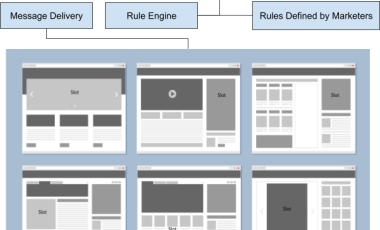
The message delivery system consists of slots and content visible to the visitor. It is responsible for displaying personalized messages to the user in real time, considering the rules and recommendations provided by the personalization engine.
Rule Engine
This component determines whether a message should be displayed to a user. The Rule Engine takes inputs from the persona detection engine and personalization engine. It applies the rules set by the marketer or the business to decide whether a message should be displayed.
Reports and Analytics
The system should have a tighter integration with analytics and visualization systems to track the performance of the personalized messages, including the number of impressions, click-through rate, and funnel visualization. This data helps the marketer understand how well the personalization system works and make data-driven decisions to improve overall performance.

The rule engine we have implemented is currently able to identify
- Where the visitor comes from - Referral, Source, Geography, Advertisement campaigns, Email campaigns
- Repeat visitor
- The interest of the visitor is based on the content they have accessed
- Whether the visitor accessed any landing pages but did not submit the form
- Whether the visitor submit any form on the website before?
- Whether the visitor is in a specific topic cluster?
- And many more
Currently, the system can display content from tools like Hubspot and OptinMonster, HTML content, and Drupal Blocks based on user behaviour and rules defined by the marketers.
The goal is to design a modular and integration-ready system where marketers can integrate with any customer data portals or AI-based persona detection systems.
We are working on an end-to-end demo for this system on our website. Let me know if you want an early preview or more details about this project.